LED screen or projector: which suits each event
It depends on the light in the room, the distance to the back row and what will be shown. This is how we decide, with set-ups we have done in Palma.
When someone calls us about LED screen hire for events in Mallorca, the same question nearly always comes up: do we need LED, or will a projector do? There is no single answer. It depends on how much light there is in the room, what time the event is, where the back row sits and what will be shown on screen. Here is how we think it through, with examples from real set-ups.
The equipment we use
We work with 10 mm LED screens for outdoors and 3.8 mm for indoors, video walls, LED plasma and TFT screens, and projectors.
Those millimetres are the distance between pixels, what the industry calls pitch. The smaller it is, the sharper the image looks up close. That is why 3.8 mm is used indoors, where the audience is a few metres away, and 10 mm outdoors, where people watch from further back and what matters is that the image holds up in sunlight.
LED screens are built from modules, so they don’t come in a fixed size. We assemble whatever surface the space calls for: long, tall, split into several pieces or hung from a structure.
When LED screen hire is worth it
When there is light
Projection needs darkness to look good. LED gives off its own light and stays visible in a lit room or at a daytime event. In Mallorca, with so many events on terraces, in harbours and in gardens, this is often the deciding factor.
At Sail Racing PalmaVela we installed an outdoor LED screen on the terrace of the Real Club Náutico de Palma for the prize-giving. It showed footage of the racing while the sailors gathered in front, in broad daylight.
When the format isn’t a standard rectangle
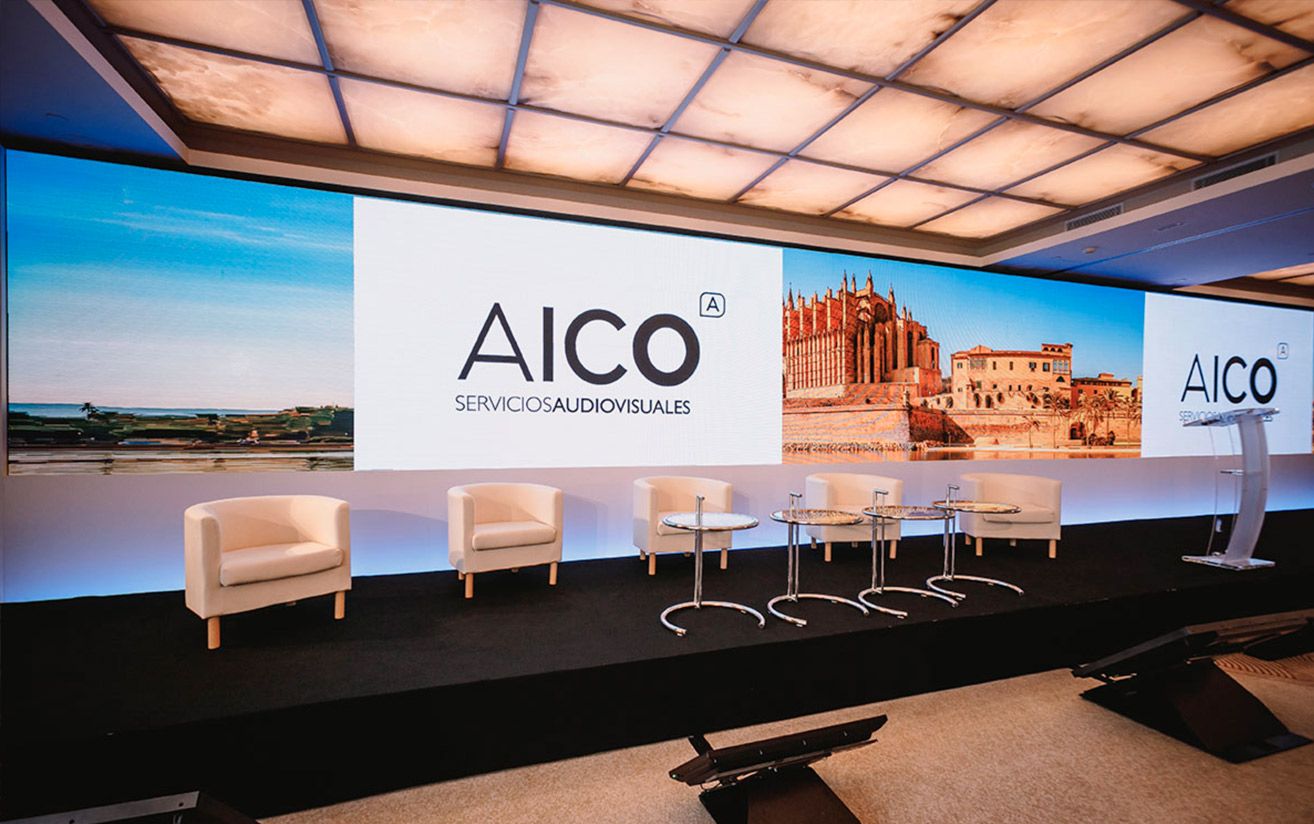
Because it is built from modules, LED adapts to formats that would be awkward with a projector. At the CVC Capital Partners IO Offsite, at the Castillo Hotel Son Vida, the screen ran the full width of the back wall. It could work as a whole or be divided into zones: at times showing images of the cathedral and Palma, at times the welcome message with CVC’s branding at either end.
At the Nikki Beach Opening Party we went further and built screens cut into geometric shapes, without a single rectangle.
When everyone needs a good view
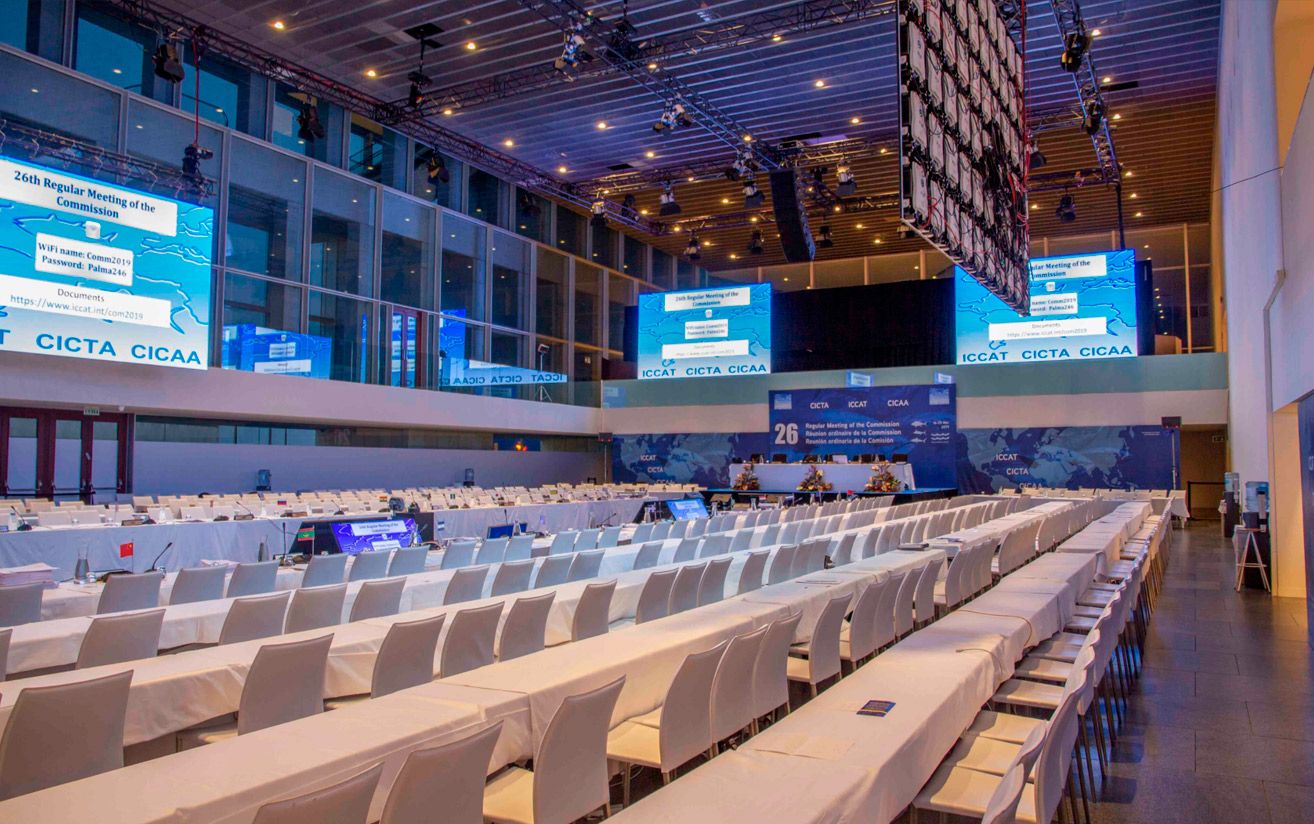
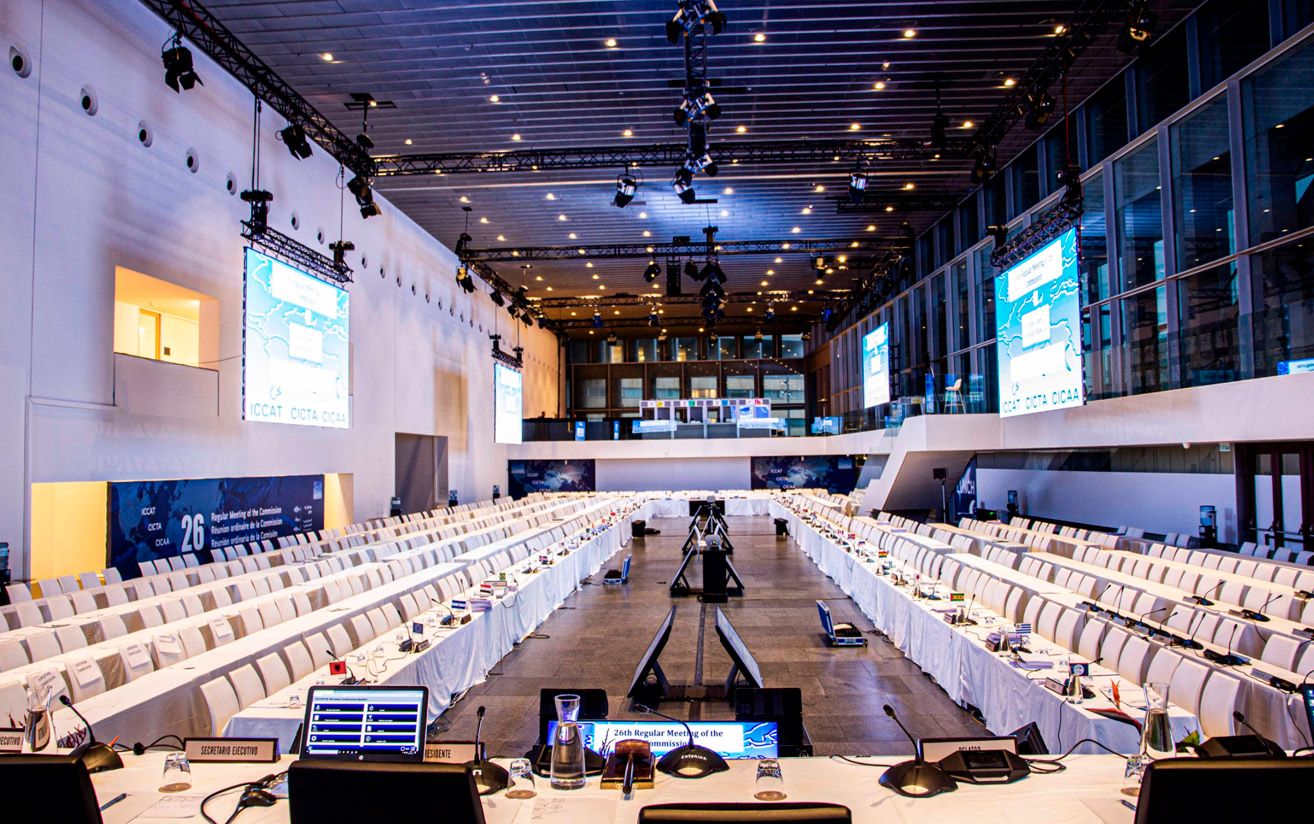
At the 26th ICCAT Meeting, at the Palma Congress Centre, we spread five giant LED screens around the room. Two robotic cameras followed whoever had the floor and that image appeared on all of them, so the view from the back row was as good as from the chair’s table. We also placed eleven support monitors beside the top table.
When a projector is still a good option
Projection is far from obsolete. In a darkened room it looks very good, the screen is lighter and the set-up is usually simpler. In many cases it also works out cheaper.
For the Banco Sabadell meeting at the Auditorium de Palma we placed a large-format projection screen at the back of a stage designed to look like a tennis court. During the talk we darkened the room and kept light only on the court and the image. For that format, a seated conversation in a dark auditorium, the projector worked perfectly.
What you need to watch with projection is the stage lighting. If the lights on the speakers spill onto the screen, the image washes out. A projector also needs its throw distance and a clear path to the screen, which in some rooms means hanging it or finding another position.
Distance, size and content
A rule of thumb widely used in the industry: the minimum comfortable viewing distance for an LED screen, in metres, is roughly the pitch figure in millimetres. Any closer and the pixels start to show. It is a guide, not a law, but it helps avoid putting an outdoor screen two metres from the audience.
Size depends on the back row. In long rooms it is sometimes better to repeat the signal than to install one huge screen. At the Spanish Urology Association meeting, at the Meliá Palma Marina, we placed monitors on stands along the sides and between the rows. That way nobody had to follow the slides from the back.
Then there is the content. A panoramic LED screen doesn’t have the proportions of a standard presentation, so the material has to be prepared for that format, or you decide what goes in each zone. At the Hero meeting at Son Vida the panoramic screen sometimes showed a single image and sometimes was split in two. If needed, our design and motion graphics team can produce that content too.
What we need to know to recommend one
With these details we can tell you which screen makes sense, and what size:
- The venue, and whether the event is indoors or outdoors.
- The time: a midday event is not the same as a dinner.
- Guest numbers and the approximate distance to the back row.
- What will be shown: presentations, videos, live camera or all at once.
- Whether things can be hung from the ceiling or have to be ground-stacked.
Every screen comes with our technicians, who install it, test it and operate it throughout the event. There is more detail on our equipment under audiovisual technology and on our page about audiovisual services in Mallorca. If you already have a date and a venue, drop us a line and we will take a look.
Projects mentioned
Shall we talk about your event?