How to organise a congress at the Palma Congress Centre
We have an office inside the Palma Congress Centre and have produced institutional meetings, thousand-person conventions and medical congresses there. What is worth sorting out before the delegates arrive.
If you are thinking of organising a congress in Palma, the Palma Congress Centre (Palacio de Congresos) is very likely on your list. It is a seafront building with a large auditorium, rooms of different sizes and a glass-fronted foyer that offers a lot of possibilities. We have an office inside the building itself, on Calle Felicià Fuster, in addition to our head office in Can Valero, and we have produced congresses, conventions, galas and institutional meetings there.
This guide is no substitute for the venue’s own team, which is run by Meliá Hotels International. It is what we see from the technical and production side: which questions are worth answering early so that everything fits together on the day.
Organising a congress in Palma starts with the programme
Before talking about screens, you need a clear programme. How many sessions run at the same time? Does everything happen in the auditorium, or are there breakout rooms? Is there an exhibition area? Is there a dinner?
The building lets you combine spaces. At SReXperts 2024, the Nokia event, the congress used the auditorium, a second stage and the glass-fronted foyer, which was used as an exhibition area with stands. Each needed a different solution: in the auditorium, a screen framed by vertical light bars; on the second stage, a central screen and a wash of blue light; in the foyer, stands with monitors and high tables on coloured carpets.
At BD’s EMEA meeting the programme had two parts, a session in the auditorium and a dinner in another room in the building. That is two different technical set-ups prepared at the same time.
The room layout
A medical congress with presentations is nothing like a negotiation between delegations. The room layout changes everything: where the screens go, how many microphones are needed and how people move around.
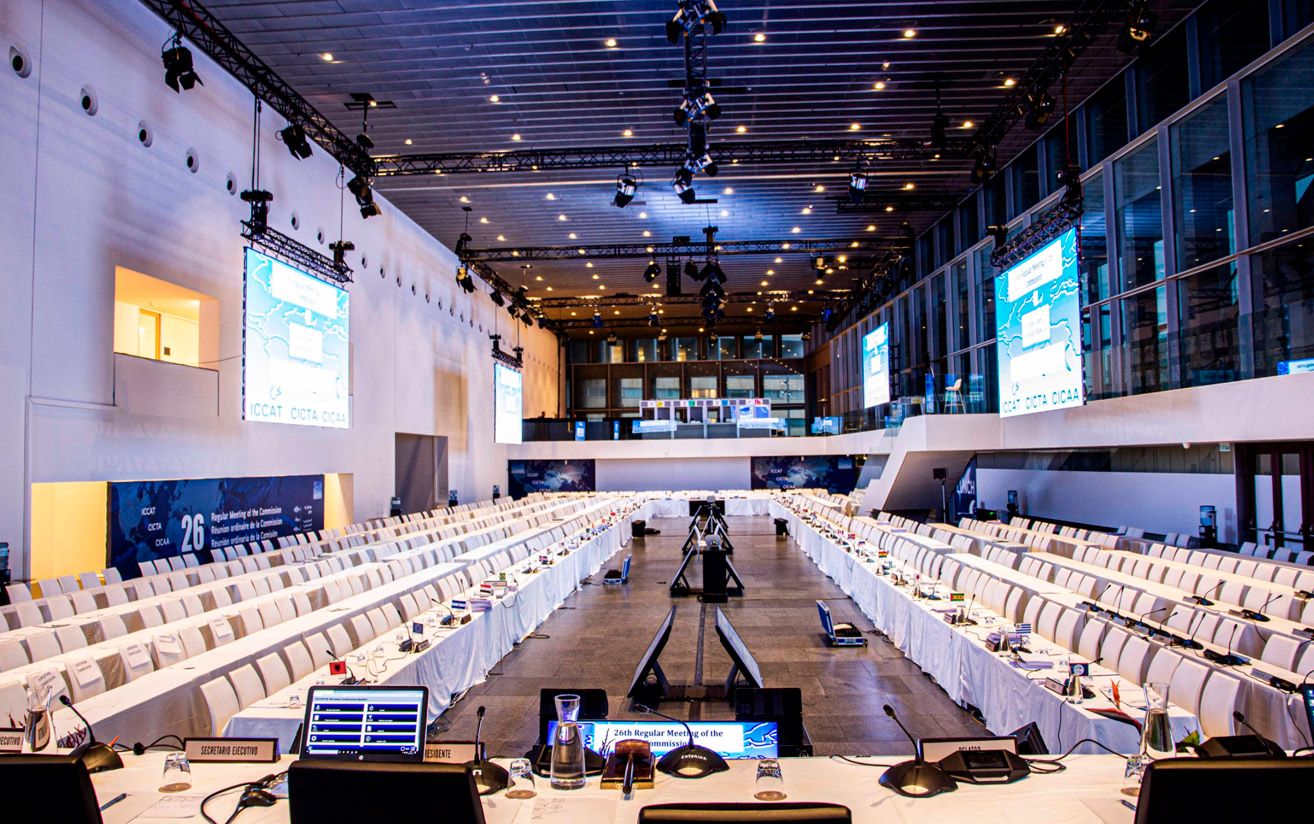
The 26th ICCAT Meeting is the most demanding job we have done there. Hundreds of delegate positions in rows, each with its own microphone on the Bosch Dicentis conference system. Two robotic cameras followed whoever was speaking, and their image was shown on five giant LED screens spread around the room. Next to the chair’s table we added eleven support monitors.
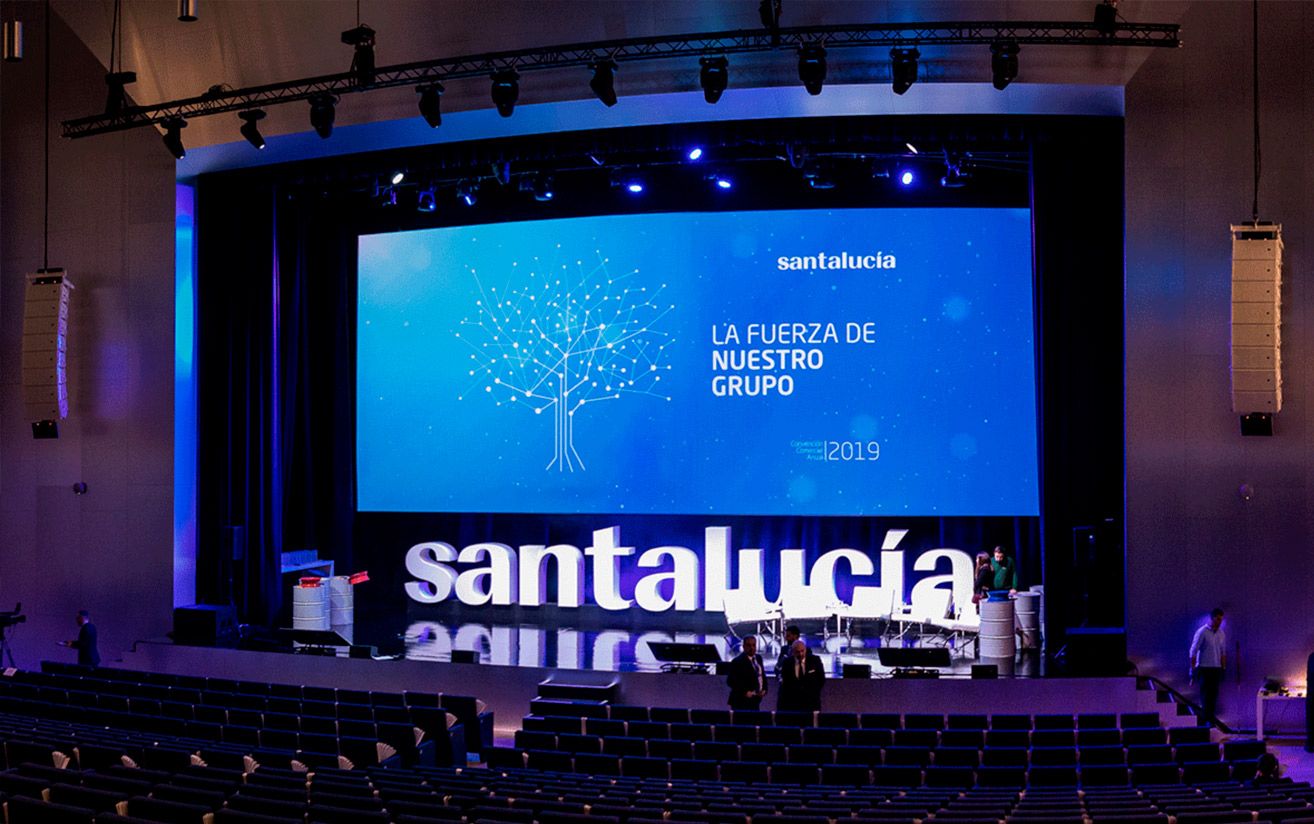
At a company convention, on the other hand, the audience faces a single stage. For the Santalucía convention, with around 1,000 people, the auditorium worked with one large screen and sound from speakers flown on either side of the stage.
Languages and simultaneous interpreting
If the congress is international, interpreting needs planning from the start, because it affects the space. Booths take up room, need a view of the stage and have to be connected to the room’s sound.
We install triple ISO booths, digital transmitters and receivers with up to 32 channels, certified to current regulations, with professional interpreters specialised in different sectors. At ICCAT we set up the booths together with the conference system, and the commission’s acronym appeared in all three versions (ICCAT, CICTA and CICAA) on the screens and at the chair’s table.
Registration, foyer and signage
The first thing a delegate sees is the foyer. That is where they register, get their bearings and wait.
At the Santalucía convention we carried the event’s look onto the banner on the façade, the photocall in the foyer, the registration desk in front of the Auditori Illes Balears and the badges. The entrance was covered with blue carpet bearing the company logo. At Citya’s 30th anniversary, with more than 1,000 employees, we hung welcome banners in the foyer and on the stairs.
It is worth deciding early who designs these pieces and who prints them, because large-format banners and badges have their own lead times.
What happens outside the plenary
A large congress creates needs that don’t appear in the programme. At ICCAT we also handled the team of hosts and the meeting’s temporary offices. You need to plan where the organisers will work, where speakers will prepare and where presentations will be checked before going on stage.
Technical control
The technical control position needs a view of the stage. At ICCAT it was run by an AICO team from inside the room; at Citya it was at the back of the stalls. Sound, screens, cameras and presentation changes are all run from there.
What matters is having a technical lead who knows the programme minute by minute, and speakers who know who to hand their files to and when.
A rough timeline
- Several months ahead: programme, spaces booked and room layout.
- A few weeks before: design of the event’s look, signage and printed pieces.
- The days before: build, sound and screen checks, rehearsal with as many speakers as possible.
- On the day: technical control in the room and someone keeping an eye on every change.
If you are preparing a congress at the Palma Congress Centre, you can see what we do under event production in Mallorca and audiovisual technology. And if you would like to talk it through, our office is in the same building: get in touch.
Projects mentioned
Shall we talk about your event?